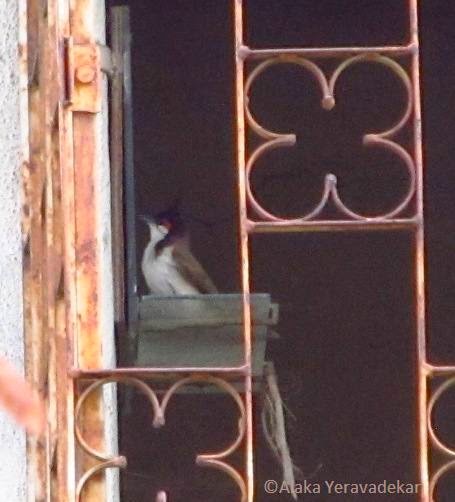
Came across this timely and very relevant email from Prof. Ulhas Rane, moderator of an e-group, Maharashtrapakshimitra. Have reproduced an edited version of it below.
-----------
'Wildlife' has become a big business, and any business is likely to become exploitative if unchecked.
Unfortunately the so-called 'nature lovers' do not realize that they destroy the 'item' which fetches them money, name, and fame. It is more unfortunate that it is being rampantly done under the garb of Nature Awareness and Study Programs.
The disease of unethical bird-watching and photography that has emerged over the last 15-20 years, has grown to an enormous scale, perhaps due to the advent of technology and easy availability of equipment - whether digital camera, powerful flashes, voice recorder or mobile phone. The market potential for such 'rare' items has also increased due to mushrooming of glossy magazines, books, newspapers and even TV media. This is affecting our wildlife adversely and would further destroy our already endangered rare species of wildlife, particularly birds.
There are simple 'dos and don'ts' everyone need to follow, to not only enjoy nature experiences themselves but also to leave them undisturbed for the others to enjoy. Most of us are aware of such norms. However now we need to add more such guidelines and rules because of the advent of new technology and new tricks.
Going in large groups in the wild areas, disturbing natural ecosystems with over-active movements (sometimes called 'enthusiasm'!), making a loud noise, throwing litter (now plastic water bottles), getting drunk and out of control (including throwing empty bottles particularly in the streams), shouting and screaming with excitement on seeing something new, collecting rare plants, flowers, insects, are some of the common behaviors displayed by many 'nature lovers'.
The next stage has more serious consequences: climbing trees and inspecting nests, collecting nests and eggs, trying to go very close to wildlife to have a 'good' look, encircling resting wildlife for tourists to get a closer look, getting down from the vehicle or elephant in the national parks (where one is not allowed to walk) to get a good picture of a rare butterfly or even to collect the same (this happens mostly by bribing forest guards, drivers or mahouts).
This continues at times to the advanced stage of trading wildlife as collection items and mementoes.
Then there are the callous and unethical wildlife photographers.
Nests are photographed by carrying out 'gardening' (removing leaves, weeds, grass etc. around the nest) to get a ‘wow’ photo. In the process, these nests - bereft of camouflage - are left prone to predator attacks. Many a times the birds are compelled to abandon them.
The chicks are tortured or lured to open their beaks, give good poses etc. Powerful flashes are used to get 'bright & beautiful' pictures without considering that the creatures may get blinded.
And finally, to have the exclusivity of one's rare picture, there are those who destroy the nest or animal so that no one else can get the same opportunity. Many lure local tribals with money to show them nests or to attract or trap birds and animals using their traditional methods.
This becomes another business for tribals and is cleverly termed as employment generation!
A relatively recent emergence is the use of tape recorders and audio players. This comes with some amount of advancement of one's nature study endeavors.
Many birds respond to the calls of their own species. These devices are used to track the birds, particularly rare, elusive and crepuscular or nocturnal birds. The recorded calls are played in the wild. Those rare birds are fooled into coming near to the photographers so that they can have a 'good' look, take close-up pictures and then laugh at how the foolish bird was cheated. Many a times, cell phones are used to play this trick.
This is being done in the remote forests (particularly Northeast India) not just by photographers but mainly by so called 'wildlife tour organizers'. They guarantee you the sighting of a rare bird or animal so that you pay hefty amounts for such tours.
Many a time wild-lifers with initial good intent move on to using these tricks due to over-enthusiasm, money, competition or jealously. When cautioned, they become defensive.
All of this needs to be stopped if we wish to have these flora and fauna left in our midst. And the main responsibility of prevention lies with nature tourism groups who take people to these wild areas.
We need to inculcate simple ethics in upcoming nature lovers by teaching them how to experience and enjoy the natural ecosystem.
Calls, pugmarks, scratch marks, smells etc. are the evidence of the existence of wildlife in the ecosystem and one should enjoy the excitement of being a 'nature detective'. This would give satisfaction even though the tourist may not have 'seen' a single creature. Sighting a wild animal is of course fun, and may eventually happen with repeated forays into the wilderness that do not disturb the natural environment. Only such ‘ethical’ love for nature can truly help nature conservation.
We should enjoy nature by following simple ethics of doing what is good for wildlife!
-----------
Prof. Ulhas Rane is Director: www.envirodesigners.com and may be contacted at ulhas AT envirodesigners DOT com