Showing posts with label birds. Show all posts

Thursday

The urban kingfisher

Kingfishers are not uncommon where I live. These days they even come and perch on cable and electricity wires high up in the sky and from there make their shrill calls.

Often I have seen a fisher meditating on a low branch next to a pond take a sudden swoop into the water. It emerges in a jiffy with a flash of turquoise, triumphant, a fish in its beak. Today was more interesting. This particular specimen was perched on a cable wire near a tarred road. Suddenly it swooped down low on to the road surface, picked up something in its beak and went back to its original wiry perch. Just another example of how birds adapt to the urban environment.

(Photo clicked elsewhere by me)

Saturday

Oddly behaving Oriental Magpie Robins

There is this OMR pair that lives near my home. Throughout the day one sees them flitting here and there, chasing each other, trying to find food or simply trilling for the heck of it. The pair also nests every monsoon and while the nest itself is not in a visible place the sounds emerging from it are quite audible. 

But to get back to this evening: The robins were awake for more than an hour after darkness had fallen and all other birds had vanished for the night. There is a street light that comes on around sunset. These two robins kept hanging around close to this lamp, swooping and diving to catch the insects and flies fluttering around the light. This went on for quite a while. In between all this hunting the pair would call to each other in a very low pitched bass call that sounded like ‘streak’ or ‘chreek’; very different from the louder ‘chuk chirrup’ they use during the day, or the melodious song of the male heard from treetops during the breeding season.
 

This is the first time (or maybe second) I’ve seen these birds make use of night/artificial light so effectively, delaying their sleep time considerably in the process. Of course I'm not at my observation post every evening so cannot be sure how frequently this happens. 


Would be interested in any observations and explanations from birders.


Wednesday

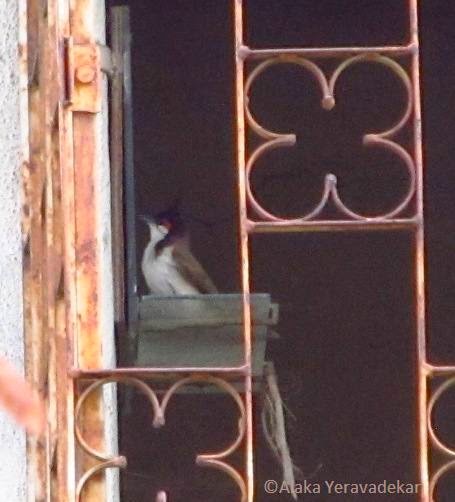
The Bulbul and the mirror

Every year around April-May the red whiskered Bulbuls arrive. From their overall behavior it appears to be their breeding season. There is an old unoccupied house, which one particular pair seems to like. The balcony has a mirror. One Bulbul in particular seems to like watching itself in the mirror. It also flies up and down a few times and stares at the reflection. Then it flies away. It does this at least few times everyday. I have been observing this for the last 2 years. 

Photos are not great in terms of clarity due to the distance and an ordinary camera. Taken for record. What is of interest here is the behavior of this bird.


Sunday

Nothing to crow about

One Sunday morning, strolling about in search of interesting clicks, I found this crow near a garbage dump on the roadside, eager to finish the half-eaten packet of snacks. The level of hygiene in this city is in fact rather low just now. Overflowing garbage bins have become the norm. And that is what the crows thrive on.  

Possessed of a high level of intelligence and highly adept at adapting to the environment, the crow is the contemporary urban bird. But inspite of all that familiarity with the urban environment, snapping it was a bit of a challenge, because the moment I aimed my camera from a distance it became wary and edgy, its flight instinct very much alive.

Tuesday

Coppersmith Barbet

The call is usually what gives its presence away- a loud rather metallic tuk…tuk…tuk (or tunk), reminiscent of a copper sheet being beaten, that has also given  the bird its name.

The Coppersmith Barbet, Crimson-breasted Barbet or Coppersmith (Megalaima haemacephala), is a bird with crimson forehead and throat which is best known for its metronomic call that has been likened to a coppersmith striking metal with a hammer. It is a resident found in South Asia and parts of Southeast Asia. Like other barbets, they chisel out a hole inside a tree to build their nest. They are mainly fruit eating but will take sometimes insects, especially winged termites.


Clicked @Pune University.  All photos (c) Alaka Yeravadekar


This species of barbet is found to overlap in range with several larger barbets in most of South Asia. In the Western Ghats, it partly overlaps with the Malabar Barbet which is of a very similar size but having a more rapid call. The red forehead, yellow eye-ring and throat patch with streaked underside and green upperparts, it is fairly distinctive. Juveniles are duller and lack the red patches. The sexes are alike. The Sri Lankan form has more black on the face, more red on the breast and darker streaks on the underside. During the nesting season, the wear and tear on the feathers can cause the plumage of the upper back to appear bluish.

Throughout their wide range they are found in gardens, groves and sparse woodland. Habitats with trees having dead wood suitable for excavation is said to be important. Birds nest and roost in cavities.

They compete with other cavity nesting birds and frugivores. Megalaima asiatica have been noted to evict them from their nest holes, while Red-vented Bulbuls have been seen to indulge in kleptoparasitism, robbing the male of berries brought to the female at the nest.

(Above information from Wikipedia)

Sunday

parakeets and mynas

Every year around June - July, a drama unfolds near my home.

The characters in this drama:

Common Myna – somewhat smaller in size than the parakeet. Equally raucous and a chatterbox.


Rose Ringed Parakeet – A noisy raucous bird often found in cities of India. Lives in gregarious flocks. Loves the eating fruits of sonchafa (michelia champaka) tree.


The coveted nesting place – a small pipe hole in a building wall. A piece of prime property in the avian kingdom!

Every year without fail the mynas use this hole for nesting. Every year around June, I see atleast one Myna chick - unsure of itself, trying to take its first wing flaps. The adult Mynas anxiously sit nearby, alternately trying to coax it and push it to fly.


Around the same time, the parakeets arrive. They are fond of the fleshy champaka (sonchafa) fruits which are a beautiful red from inside. The parakeets have also spotted this hole as suitable for nesting.


For a few days there is a fight between the mynas and the parakeets over the pipe hole. The parakeets eventually manage to drive away the mynas and take control of the nesting place.


Reminds me of a certain old Hindi film song :-)